
2023 Medium-Term Budget Policy Statement Preview: Fiscal Prudence in Uncertain Times
- Posted by ukzn-admin
- Categories News
- Date October 23, 2023
2023 Medium-Term Budget Policy Statement Preview: Fiscal Prudence in Uncertain Times
South Africa’s National Treasury will table the Medium-Term Budget Policy Statement (MTBPS) in Parliament early in November. The MTBPS outlines government policy objectives and priorities and presents a fiscal framework for the mid-term and upcoming three years by outlining revenue estimates and spending. As we approach the MTBPS presentation, it is essential to recognise that the fiscal outlook is notably more susceptible to risks pertaining to revenue rather than expenses, which originates mainly from a large year-to-date decline in government tax revenue collections (estimated at R22bn for the first five months of the year) and tighter financial conditions that have constrained government’s borrowing programme, as reported by the Treasury.
Therefore, it becomes evident that during the upcoming MTBPS, the Minister will be compelled to deliver a comprehensive exposition of long-standing fiscal policy and reforms that will foster economic growth, tax revenue generation, and stimulate investments, albeit with a suitable quantum and complement of austerity measures in the immediate term, alongside the imperative of following through on their implementation. There needs to be care in the delivery of a clear debt consolidation plan, realignment of expenditures to align with reduced tax revenues and funding derived from the borrowing programme, as well as the provision of crucial information concerning the National Assembly-endorsed National Health Insurance Bill (NHI), among other critical aspects.
Debt Consolidation
Ms Mamokete Litjane, who serves as the Global Markets Strategist at Standard Bank CIB, posits that ‘IMF data show that SA (South Africa) has had the second-highest escalation of debt to GDP of all the large emerging markets in the past five years and will have the same ranking in the coming five.’
This is evident through the inflation of the debt-to-GDP ratio from 27% to 74% in a mere decade, which has led to net interest payments forecasted to rise to 28.3% of government revenues by 2027, up from 13.4% in 2019. Moreover, the IMF expects the government debt to reach 80% of GDP in 2025, above the government forecast of a peak of nearly 74%. Furthermore, the government’s budget deficit is projected to widen to an average of 7.2% of GDP between 2024 and 2027 from 5.8%.
While the risk of default is not yet imminent, there has been a recent sell-off in local bonds, primarily by foreign investors. Notably, their share among bondholders has diminished from 40% to 25% within a span of four years, as reported in the SARB financial stability review. These trends serve as subtle indicators that the confidence of financial and capital markets is waning, influenced by our prevailing socio-economic challenges, including the escalation of debt levels.
As Litjane stated: ‘The debt dynamic has created a toxic mix of rates, the Rand and domestic assets in general. Moreover, the state’s ability to respond to crises big and small is now severely constrained.’
Although the nation faces isolated and unique socio-economic challenges, the Minister must observe Dubai’s Public Debt Management Office (which was able to reduce their debt-to-GDP to GDP ratio from 78% in 2020 to 25% to date) and submit a debt consolidation plan that will put our economy on a better path.
National Health Insurance.
A plethora of concerns envelop the NHI, predominantly centred on the widely shared consensus that the nation lacks the requisite capacity and resources to support the proposed single-fund system. Obscure estimates from the department indicate an allocation of approximately R500 billion to R700 billion annually for this initiative, financed through general revenue tax, reallocation of medical scheme tax credits presently paid to various medical schemes, payroll tax, and personal income tax, according to the provisions of the Bill.
While the Bill must traverse an extensive legislative journey before securing presidential approval and implementation, the looming short-to-medium-term unintended consequences of its acceptance by the National Assembly this year are palpable, considering the headwinds confronting the nation. Thus, it is imperative that the Treasury submit comprehensive provisions on crucial facets of the Bill, with particular emphasis on its funding structure and programme costs.
Spending Adjustments
As reported by Bloomberg, the Minister was anticipated to present President Cyril Ramaphosa with a cost-saving plan which reportedly entails provisions for reducing government departments, and programmes, consolidating state-owned enterprises and potential tax hikes. While the extent of the provisions is still speculative, there is a clear and growing sentiment in the MTBPS austerity. The Minister is anticipated to provide clarity/updates pertaining to these matters during the MTBPS as well as the 7% Public wage increase (for the next fiscal year) agreed with COSATU in March, and the stance on the COVID-19 social relief of distress grant which was extended to 31 March, 2024, among others. While being cognisant of the risk of politically incentivised policy adventurism, the Minister must proceed with caution and discipline in dealing with expenditures, considering the tighter revenue expectations. The ramifications for politically incentivised and/or “out-of-budget” expenditures will most likely outweigh the benefits.
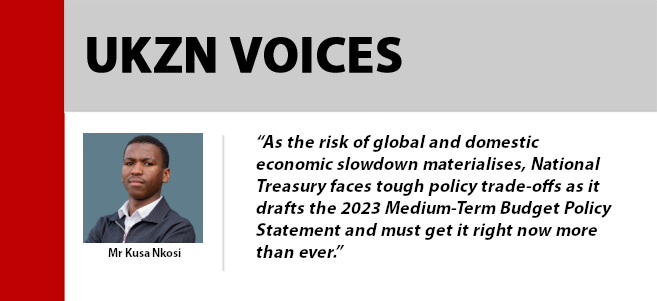
As the risk of global and domestic economic slowdown materialises, National Treasury faces tough policy trade-offs as it drafts the 2023 Medium-Term Budget Policy Statement and must get it right now more than ever. As Trevor Manuel submits: ‘The South African economy is like a diamond in the rough. With the right policies and reforms, it can shine and become a beacon of growth and prosperity.’
- Mr Kusa Nkosi is a Postgraduate Diploma in Finance, Banking and Investment Management student at UKZN.
*The views and opinions expressed in this article are those of the author and do not necessarily reflect the official policy or position of the University of KwaZulu-Natal.

You may also like

UKZN Student Broadens Academic and Cultural Horizons in Finland

UTLO Symposium Advances Digital Curriculum Transformation
