
2025 Budget – A Value-Added Tax View
- Posted by ukzn-admin
- Categories News
- Date March 31, 2025
The 2025 South African national Budget, initially set for 19 February, was postponed due to disagreements within the Government of National Unity (GNU) Cabinet. Speaker Thoko Didiza cited the need for a ‘collegial and mature consensus.’
Finance Minister Enoch Godongwana delivered the speech on 12 March 2025. The delay was unprecedented. Notably, this is the first time in South Africa’s 31 years of democracy that the Budget speech was postponed.
The disagreement within Cabinet was believed to stem from several factors, with the key issue reportedly being an increase in Value Added Tax (VAT). A form of indirect consumer tax, VAT is governed by the Value Added Tax Act No. 89 of 1991. The tax was raised from 14% to 15% in April 2018, and the Government initially proposed an additional increase of 2%, to up the rate from 15% to 17%. This proposal has sparked considerable debate, as VAT is the second-largest contributor to South Africa’s tax revenue after personal income tax (Moneyweb, 2025).
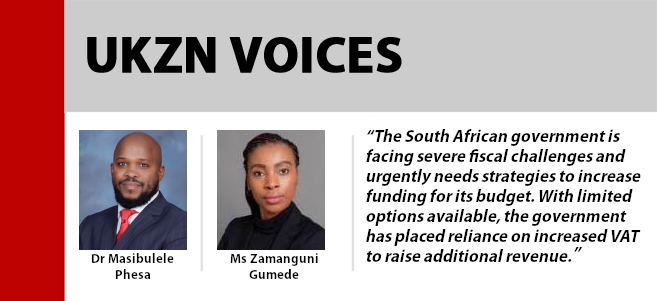
The South African government is facing severe fiscal challenges and urgently needs strategies to increase funding for its budget. With limited options available, the government has placed reliance on increased VAT to raise additional revenue. South Africa is currently grappling with a growing budget deficit projected to be 4.9% of the 2023/24 Gross Domestic Product (GDP). Additionally, the country is burdened with a substantial debt ratio of 75% of GDP (Trading Economics, 2025). Given these financial constraints, increasing VAT may have been one of the few viable options to bridge the fiscal gap.
Public Concern
The proposed VAT increase is a significant concern for South Africans, especially the country’s most vulnerable citizens, often referred to as “the poor of the poorest”. A conflicting government goal is at work, with programmes aimed at improving an unequal society while enacting laws that continue to keep the most impoverished, those who are affected by the disparity. According to the lead economist at KPMG, Mr Frank Blackmore, the VAT hike will exacerbate financial struggles, deepen poverty, and make food less accessible. Consequently, this could raise questions about the country’s food security, a critical issue, as highlighted in the World Health Organization’s report published on 6 July 2022.
At a macroeconomic level, this stance affects inflation and economic growth, with export-oriented businesses and the tourism industry being some of the most affected. While revenue targets will be met to a large extent, the risk is higher than the current 4%-5% inflation rate and reduced consumer goods and service demand due to higher prices.
But what of the already vulnerable South African citizens, typically in a setting of low-income households and small, medium, and micro enterprises (SMMEs)? The proposed VAT increase presents no end in sight for their daily woes.
Taxpayer Relief
According to the revised proposal by the Minister of Finance to increase the VAT rate by 0.5 percentage points in 2025/26 and by 0.5% in 2026/27, there remains a need to consider measures to reduce the burden on taxpayers.
- Zero-Rated Supply
Currently, under Section 11(j) of the VAT Act, relief provided includes goods consisting of 21 essential foodstuffs, as outlined in Part B of Schedule 2. It has been proposed that the items listed in Part B of Schedule 2 be extended. The zero-rated foodstuff list is important to note, as individuals affected by VAT may, if they haven’t already, review their grocery shopping habits to limit the extra VAT-related costs.
Notably, these items are not zero-rated when supplied ready for immediate consumption, as outlined in Section 11(j), Part B of Schedule 2. Proper use of the goods on this list can benefit the end user. The key question, however, is whether the end users, particularly those categorised as low-income households, are aware of and understand this relief.
- Exempt Supply
Although limited in number, there are notable exempt supplies categorised as necessities for struggling South African taxpayers, as outlined in Section 12. These exemptions provide additional relief beyond the zero-rated supplies already offered by the government.
These supplies include financial services, a supply of a dwelling for letting, supply of fare-paying passengers other than game viewing, educational activities, services of caring for children by crèches or aftercare schools, goods supplied by the Bargaining Council, and goods supplied by a political party to its members in a form of membership contribution.
Proposed Concession
In any situation where conflicting interests arise, a trade-off and compromise are necessary. The reduced percentage increase reflected that the government, to an extent, took heed of the public outcry against the initial proposal of a 2% increase. Although not ideal, this approach would be more gradual and lessen the immediate burden on consumers.
While the Finance Minister adjusted the percentage increase, it is inadequate as the issue of resorting to a VAT increase, regardless of the percentage, points to various underlying problems that the Treasury needs to address.
The Government could further explore other options within the VAT Act. For instance, it may limit or modify zero-rated and exempt supplies. Some zero-rated supplies could be reclassified as standard VAT supplies, although not all, as this would disproportionately affect the most vulnerable South Africans.
Alternatively, the Government should leave VAT unchanged, given its sensitivity, and consider adjusting other forms of taxes, such as personal income or corporate tax. While this would come with challenges and likely resistance, it could be a more equitable solution than raising VAT beyond the proposed percentages in upcoming years.
As previously explored by the Government, a low-hanging fruit that continues to bear fruit is increasing the SARS resources support fund to efficiently collect all state taxes in the short-term (2025/26). The SARS debt recovery initiatives cannot be underestimated at a time when the government so desperately needs to fulfill its core mandate and is running out of creative ideas to collect revenue and grow the economy.
Dr Masibulele Phesa is a Senior Lecturer in Taxation at UKZN.
Ms Zamanguni Gumede is a Senior Lecturer specialising in Taxation at UKZN.
*The views and opinions expressed in this article are those of the author and do not necessarily reflect the official policy or position of the University of KwaZulu-Natal.
Photographs: Supplied

Previous post
Mérieux NutriSciences Partners with UKZN Foundation to Support Medical Students
You may also like

UKZN Student Broadens Academic and Cultural Horizons in Finland
UTLO Symposium Advances Digital Curriculum Transformation
