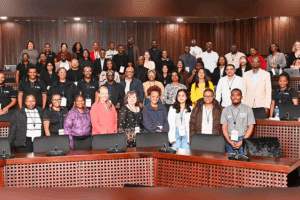
ABRUEM Engagement with Universities Encourages Sustainable Partnerships
UKZN and the Durban University of Technology (DUT) hosted a delegation of rectors from various state and municipal universities in Brazil (ABRUEM).
ABRUEM aims to foster dialogue and exchange between Brazilian and South African institutions and establish a global network in the fields of agriculture, health, engineering, education and law.
The programme was directed by the Executive Director of Corporate Relations at UKZN, Ms Normah Zondo.
Professor Mosa Moshabela, Deputy Vice-Chancellor of Research and Innovation, said it was a pleasure to welcome the delegates on behalf of Vice-Chancellor Professor Nana Poku and UKZN Executive Management.
Highlighting the history of UKZN, which was founded in 2004 following the merger of the Universities of Natal and Durban-Westville, he noted that the student population of 46 000 spread over five campuses includes students from South Africa, Africa, China, India, Europe and the United States. ‘Driven by research, our four Colleges house 68 research centres and units performing ground-breaking work in the fields of engineering, robotics, science and medicine. We are also home to Professor Tulio de Oliveira, who in 2021 was the first to discover the COVID-19 Omicron variant.’
With South Africa hosting the 15th BRICS Summit, Moshabela added that UKZN boasts 15 strategic partnerships with universities in Brazil, Russia, India and China. ‘We would like to increase the number of partnerships and collaborations. Together, we can be the changemakers of the future, visionaries and leaders who shape not only our own destinations but those of future generations.’
DUT Deputy Vice-Chancellor of Research, Innovation and Engagement, Professor Fulufhelo Nemavhola shared Envision 2030, the institution’s 10-year strategic plan that sets out the principles and values that will enable it to make a positive impact in society. He listed opportunities for collaboration through tools such as online learning, international/virtual webinars, student and staff mobility programmes and joint programmes with other universities. Nemavhola said South Africa and Brazil share common challenges and could use platforms such as these to ensure that their collaborations solve global problems.
Professor Odilon Máximo de Marais, Rector of the State University of Alagoas and President of ABRUEM, said it is an important institution that brings together Brazilian state and municipal universities. ‘Our mission in South Africa is to bring our institutions closer together to improve our scientific research and develop new innovative technologies that will improve citizens’ lives. We appreciate your warm reception and hope to forge agreements and partnerships that will strengthen our institutions.’
Professor Michael Brooks of the Aerospace Systems Research Institute (ASRI) in UKZN’s School of Engineering said the institute’s mission is to leverage South African academic talent and develop commercialisable rocket propulsion and aerospace technologies through hybrid rocket systems, suborbital and orbital rocket design and liquid propulsion. Encouraging collaborations to bring sounding rocket missions to South Africa, Brooks highlighted the development of a sounding rocket launch gantry at Overberg Test Range, in the Western Cape with the capability of launching international sounding rockets, including those from Brazil, such as the VSB30.
Delegates visited UKZN’s Gandhi-Luthuli Documentation Centre and the Centre in Indigenous Knowledge Systems (CIKS), which is the hub of the African Institute in Indigenous Knowledge Systems (AIIKS). Professor Hassan Kaya, Director of the CIKS and Co-ordinator of the AIIKS, outlined the centre’s mandate to protect, preserve and promote African Indigenous Knowledge Systems through research and human capital development.
Breakaway sessions on topics such as Innovation in Internationalisation, Focusing on Future Mobility for International Collaborations, Reshaping Internationalisation through Strategic Partnerships, and the Role of Collaborative Online International Planning in Advancing Internationalisation explored common interests and practices and collaborations to strengthen internationalisation.
Words: Hlengiwe Khwela
Photograph: Creative Dime Studios