In many South African classrooms, the future is being taught without the tools it was designed for.
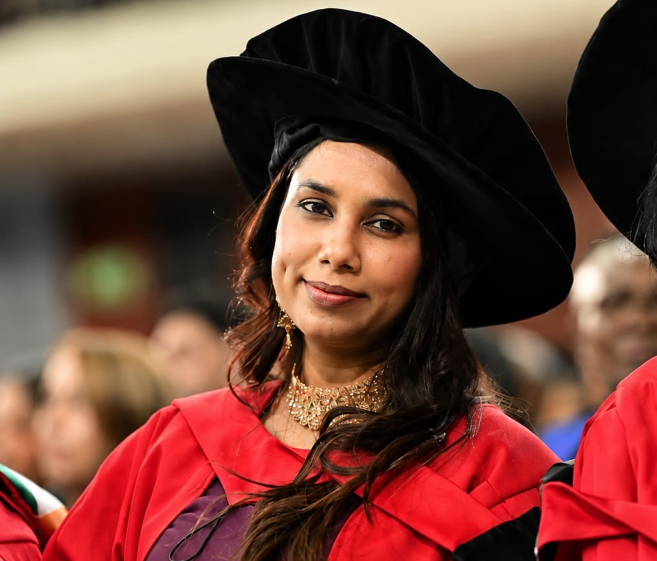
This is the reality explored in Dr Pranitha Chunder’s PhD study, ‘Teachers’ Experiences of the Implementation and Teaching of the Coding and Robotics Curriculum in Primary Schools’, supervised by Dr Zanele Dube-Xaba and Dr Reginald Govender. Her research focuses on how primary school teachers are navigating the rollout of Coding and Robotics (C&R) in schools where resources are often limited or entirely absent.
An educator and school leader, Chunder’s work is grounded in lived experience. As a Master Trainer in the Coding and Robotics Unplugged programme, she worked closely with teachers and quickly noticed a pattern: many were excited about the subject, but at the same time fearful, confused and resistant when it came to actually teaching it.
At the centre of her concern was what she calls “the poor child sitting in an overcrowded classroom without a computer, without internet access and without a teacher who had been adequately prepared.” It was for this learner that her research was undertaken.
Her findings reveal just how uneven the system is. In the Pinetown District, where the study was conducted, most of the schools did not have computer labs, and several had no reliable Internet at all. In some cases, donated equipment could not be maintained or kept safe. Teachers were left to teach coding in theory only, with no opportunity for learners to practise what they were learning. Over time, learners who had initially been excited began to lose interest.
She added that what is often described as the “digital divide” becomes something far more real in these classrooms, saying that it is the difference between a learner who can experiment, build and solve problems using technology, and one who can only imagine it.
In addition, she found that teachers themselves are carrying a heavy load. Many described feeling overwhelmed, anxious and underprepared. Some spoke about feeling “lost,” while others said they felt displaced, destitute and traumatised by the demands of a subject they had never been trained to teach. Larger classes, limited support and added administrative work only made things harder.
In schools with access to resources and support, teachers spoke about “rewiring their thinking” and slowly building confidence. Even in the most under-resourced environments, many found creative ways to make the subject work.
One teacher-led activity, ‘Caryn the Crane Driver’, used simple materials and movement to teach coding concepts. Learners gave one another step-by-step instructions, effectively “programming” each other. In other classrooms, teachers blended coding into subjects like Mathematics and English, or used outdoor spaces to teach problem-solving and patterns.
These moments of creativity show that meaningful learning can happen without expensive technology, but they also highlight how much effort teachers are putting in to bridging a gap they did not create.
A key message from the study is that teachers need more than once-off training sessions. Many participants said the training they received was too fast, too technical and quickly forgotten. What made a difference, however, was ongoing, hands-on support where teachers could learn together, practise and build confidence over time.
Chunder found that without this kind of support and without proper investment in infrastructure there is a real risk of deepening inequality. Learners in well-resourced schools will continue to gain practical digital skills, while those in poorer communities fall further behind. Invariably, in a world where technology is shaping education, work and everyday life, this gap has serious consequences.
For Chunder, this is not just an education issue; it is a matter of fairness. If all children are expected to learn Coding and Robotics, then all schools must be given the means to teach it properly.
Chunder offers this message of encouragement to teachers to persevere: “Know that your work reaches the children who need you most. The poor child sitting in your classroom, in an under-resourced school in a disadvantaged community, is counting on you to open the door to a digital future that would otherwise remain firmly closed. That is not a burden, it is a calling of the highest order.”
Words: Rakshika Sibran
Photograph: Sethu Dlamini