
Convert Humanities and Social Sciences Studies into Community Projects
- Posted by ukzn-admin
- Categories News
- Date December 5, 2023
Convert Humanities and Social Sciences Studies into Community Projects
Globally the level of unemployment among graduates is growing. While this phenomenon cuts across disciplines, it is more prevalent among Humanities and Social Science graduates. A number of factors are believed to explain this, including a significant skills mismatch as graduates lack employable skills and attributes. They are poorly prepared to enter the labour market and therefore unemployed for a long period of time.
While the traditional role of universities has been to transfer knowledge and prepare graduates for the labour market, I argue that it is important to move beyond this approach. Should universities submit to the demands of the market or should their mission be to transform and reshape it through knowledge production and innovation? In my view, the role of the university should be to develop graduates capable of transforming knowledge into job creation and transforming the labour market for the betterment of graduates and society. Given the high unemployment rates in the labour market as well as rising poverty and inequalities, there are many reasons to support a new approach to social and economic development.
My argument is that universitiesshould play the role of creating job creators rather than job seekers by ensuring that the knowledge and skills they transfer are relevant to society’s challenges and needs. This can be achieved by ensuring thatgraduates are equipped with the knowledge and skills to think beyond producing academic work. Knowledge should enable them to identify and close the gap between knowledge and socio-economic problems. This calls for a redefinition of the traditional role of the transmission of theoretical and practical knowledge in different fields of study in Humanities and Social Sciences. Emphasis should be placed on applicability and action, and the possibility of transferability to various situations and contexts. It is also important to incorporate skills, attitudes and other individuals’ aptitudes that provide for competent professional practice that derives from teaching, learning and research.
My belief is that if education is to be functional, it has to be relevant and practical to the daily realities of the student and the community. This means that the acquisition of appropriate skills and the development of competencies must turn the student around; therefore, the student and the community’s development become the centre of teaching, learning and research. Students should be equipped with knowledge and skills to contribute to the development of themselves and their society. This means that the quality of instruction at all levels has to be oriented towards acquisition of the competencies required for self-reliance and poverty alleviation.
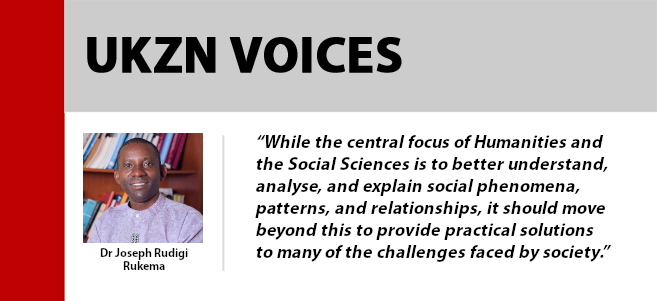
While the central focus of Humanities and the Social Sciences is to better understand, analyse, and explain social phenomena, patterns, and relationships, it should move beyond this to provide practical solutions to many of the challenges faced by society. Growing levels of unemployment, crime, violence, climate degradation, poverty and inequalities do not only require better understanding, but practical and innovative solutions. Our teaching, learning and research must be aligned to the needs of the student and the community. This entails empowering students to become self-driven and reflexive in their approach to life in general and sustainable development in particular. Significant structural reform in teaching, learning and research is thus required if the Humanities and the Social Sciences are to remain relevant and make a significant impact on the lives of graduates and society.
For the past 10 years, I have been reflecting on the possibility of converting Humanities and Social Sciences studies into community and commercial projects. I initiated numerous projects, including seminars and talks reflecting on teaching, learning and the research approach.
When I was employed by UKZN as a permanent senior lecturer in 2015, I was privileged to teach a third-year module titled: Social Issues: Theories and Practices. This module focuses on gender construction with a particular focus on gender-based violence (GBV). The students and I agreed that the module should have a theoretical and practical component. After the successful completion of the theoretical part, we agreed that GBV is a challenge faced by South African society and the world as a whole. We designed a project called United Against Gender-Based Violence with the aim of designing strategies to address this scourge in schools and the broader society. I assisted students draft the organisation’s business plan and with setting up an organisational structure. It operated as a student organisation that functioned for two years as most of its members left after completing their degrees. I hope to revive the organisation with a more sustainable approach.
In 2014, I was invited by the University of Lay Adventists of Kigali as a visiting scholar. During my stay, I developed and taught a module titled: Introduction to Environmental Philosophy. After the successful completion of the module, the students and I agreed that climate change and disaster are real challenges. We initiated a student non-profit association (Advocacy for Disaster Risk Reduction and Environmental Sustainability (ADRRES). I assisted the students to develop a project business plan, draft constitution and formally register the organisation. Since then, the project has organised numerous community projects, awareness and sensitisation campaigns, conferences and seminars on natural disasters and environmental sustainability.
I recently conducted a study among South African and foreign informal mechanics, hairdressers and construction workers in Durban. The findings show that 90% of the participants acquired skills through informal learning from friends and relatives or from established businesses and organisations. The study also revealed that the majority of the respondents are self-employed, using the skills acquired through informal learning. Informed by these findings, I initiated a non-profit organisation African Centre of Informal Learning and Entrepreneurship that is now registered as a non-profit organisation. It aims to facilitate skills acquisition through informal learning by linking knowledge seekers with established businesses to transfer skills and create jobs.
In line with my philosophy of teaching, learning and research, I developed a model through which Humanities and Social Sciences teaching, learning and research can be converted into community or commercial projects. It aims to redefine the traditional role of the transmission of theoretical and practical knowledge in different fields of study in the Humanities and the Social Sciences. The emphasis is on applicability and action, and the possibility of transferability to various situations and contexts.
Teaching and learning content is central to the model. Course contents need to be aligned to societal issues. This means that course design at all levels of study must cover theoretical, practical and implementation aspects. Theory should thus derive from real societal issues. Students should spend more time in communities to understand and analyse societal issues and this should form part of debates in class where theories can be derived.
The model suggests that students should spend 50% of the course in communities to better understand, analyse, and explain social phenomena, patterns, and relationships, 30% should be dedicated to developing theories derived from debates in class and 20% should be spent developing the implementation plan.
In order to achieve this there is a need to involve different stakeholders with different skills, including academics and individuals with community and business projects skills.
The second step of the model focuses on research. Browsing through masters and PhD theses and publications in all disciplines, my impression is that many have the potential to be turned into community or business projects, which could be the basis for closing the gap between skills and unemployment among university graduates. In order to convert research findings into community projects, the emphasis should be on research design. The methodology should go beyond merely collecting data, but go deeper to uncover the underlying social phenomena and provide solutions to societal issues. Action research is key if social issues are to be better understood and resolved.
The model also calls for a review of the existing approach to the research proposal and final research report. It suggests that research should have two components. The first should focus on academic aspects and the second on the design and implementation of the project. This means that the student should be able to show how the findings from the research will be converted into a community or commercial project.
The model recognises the challenges involved in converting Humanities and Social Sciences studies into community projects and suggests that this calls for additional skills. Project, financial management and marketing, and fundraising skills should therefore be introduced in the final year of study. There is also a need to engage different stakeholders including existing businesses, government and non-governmental organisations.
This opinion piece is intended to encourage scientific discourse that disrupts the current state of knowledge production in the Humanities and the Social Sciences. It calls for a renewed approach to teaching, learning and research that would enable Humanities and Social Sciences graduates to make a meaningful impact on society and enrich their own lives. I hope to conduct more workshops and training to test the model’s feasibility.
Dr Joseph Rudigi Rukema is a senior lecturer in Sociology at UKZN’s School of Social Sciences. He is the author of 86 publications and has graduated 10 PhD, 27 masters and 34 honours students. He is the founder and president of a community university in the Democratic Republic of the Congo, Universite de l’Afrique Sub-Saharienne (Sub-Saharan Africa University). He is a research fellow at the University of South Africa, a member of the editorial board of the Anthropology and Ethnology Open Access Journal, and has been a regular member of the National Research Foundation’s proposal review panel. Rukema is a board member of Holy Family College. He has delivered lectures as a visiting professor at 11 universities in Africa, India and the United States, and has featured among UKZN’s Top 30 researchers, organised national and international conferences, delivered keynote speeches, and reviewed numerous academic programmes, the most recent at the University of Namibia.
*The views and opinions expressed in this article are those of the author and do not necessarily reflect the official policy or position of the University of KwaZulu-Natal.

Previous post
UKZN Launches BRICS Student Commission and Student Women Economic Empowerment Project Chapter
You may also like

UKZN Student Broadens Academic and Cultural Horizons in Finland
UTLO Symposium Advances Digital Curriculum Transformation
