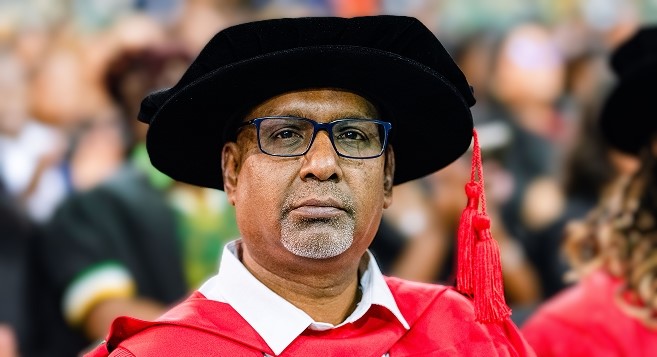
Dr Lingum Pillay’s journey in the field of psychology was shaped by his formative years in Verulam near Durban where he attended Verulam High School.
His passion for understanding human behaviour and mental health was inspired by his parents’ unwavering emphasis on education and the deep, lasting friendships he cultivated during his high school years. The contacts he made with his classmates, which have endured to this day, reinforced his desire to explore the complexities of the human mind and behaviour.
Pillay’s PhD research focused on cumulative risk and neuropsychological resilience in South African youth, a topic of immense relevance given the socio-economic disparities in the country. His study delved into the risks faced by the youth in low-income settings, with a particular emphasis on cumulative risk, exposure to violence and neurocognitive resilience.
A key contribution of his research was the development of novel cumulative risk constructs, which moved beyond the traditional additive model. His findings offer fresh perspectives on how cumulative risks impact youth development and academic performance. Furthermore, his study provides insights into shaping policies and programmes that address violence, promote emotional regulation, and enhance neurocognitive resilience among disadvantaged youth. His work has significantly contributed to the growing body of knowledge in behavioural Medicine, particularly in understanding how resilience can be fostered in vulnerable communities.
Pillay is a clinical psychologist in full-time private practice, specialising in neuropsychology, forensic psychology, trauma management, and psychotherapy. His work spans diverse cultural and population groups, reflecting his commitment to applying his expertise across South Africa’s multicultural landscape. His practice addresses a wide range of clinical conditions and he is deeply invested in helping individuals navigate psychological challenges with evidence-based therapeutic interventions.
Looking ahead, Pillay plans to continue his research and development in the field of neuropsychological resilience, with a focus on creating accessible therapeutic and intervention models. His ambition extends beyond South Africa, aiming to impact the broader African continent by developing strategies that can be implemented at both individual and community levels. His work seeks to bridge the gap between research and practice, ensuring that scientific advancements translate into real-world solutions for mental health and resilience.
Pillay’s personal journey has been deeply intertwined with South Africa’s socio-political evolution. He actively engaged in socio-political activism during his school, university, and community years, witnessing first-hand the dismantling of apartheid and the emergence of democracy. While he acknowledges the ongoing challenges of corruption, nepotism and moral decay, he remains hopeful for the future, drawing inspiration from the country’s historical resilience and achievements.
His values and life philosophies have been profoundly influenced by his parents’ dedication to education and hard work. Moreover, his involvement in community activism, leadership roles in sports, and professional engagements have further shaped his perspective on service, leadership and social justice. These experiences continue to guide him in both his personal and professional life.
Pillay attributes much of his academic and professional growth to Professor Basil Pillay, his doctoral supervisor and long-time mentor. Professor Pillay, a distinguished clinician and academic, has played an instrumental role in shaping his career. Under his mentorship, Dr Pillay has developed a rigorous approach to psychology, ensuring that his work meets the highest academic and clinical standards. ‘The mentorship I received has been invaluable in refining my expertise and reinforcing my commitment to excellence in behavioural Medicine.’
Words: Maryann Francis
Photograph: Sethu Dlamini