
Global Solidarity Essential to Ending TB
- Posted by ukzn-admin
- Categories News
- Date April 16, 2025
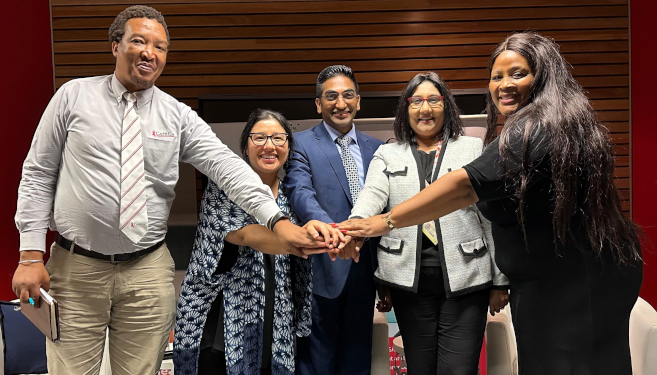
The University of KwaZulu-Natal’s (UKZN) College of Health Sciences, in partnership with the Centre for the AIDS Programme of Research in South Africa (CAPRISA) and the Africa Health Research Institute (AHRI), hosted a powerful #WorldTBDay2025 event.
The gathering united leading scientists, healthcare professionals, community activists, and policymakers in a collective effort to combat one of the world’s deadliest infectious diseases – tuberculosis (TB).
Despite medical advancements, TB – a disease that dates back centuries – continues to claim over a million lives annually, making it the world’s deadliest infectious disease.
Despite significant investments in diagnostic and treatment advancements, global progress toward eradicating TB has been slow. The World TB Day event served as a crucial platform to highlight these challenges, share new scientific findings, and call for increased commitment to ending the TB epidemic.
A major concern raised at the event was the rising number of new TB cases, exacerbated by undiagnosed and asymptomatic individuals unknowingly spreading the disease within their communities. Dr Emily Wong from AHRI emphasised the importance of active screening.
‘There must be greater awareness that even asymptomatic individuals need screening,’ she said.
‘We are finding that more asymptomatic than symptomatic individuals account for prevalent TB in communities. The question we must ask is: how do we find these people and ensure they receive the necessary treatment,’ she added.
Professor Rubeshan Perumal, a distinguished pulmonologist and recipient of UKZN’s Vice-Chancellors Top Researcher Award for 2024, acknowledged the advancements made in TB detection and treatment but highlighted the ongoing challenges.
‘Molecular diagnostic testing now provides TB detection and resistance profiling results in 1-2 hours, compared to the eight weeks it used to take just a few years ago,’ he said. ‘TB should no longer be considered a fatal condition – it is manageable and entirely curable with treatment. However, socioeconomic barriers to adherence to treatment and the emergence of drug resistance remain major issues.’
The event highlighted the complex social and economic factors that hinder TB treatment and prevention. Homelessness, poverty, food insecurity, and unemployment continue to fuel the spread of TB in South African communities.
Mr Patrick Mdletshe, the Head of the CAPRISA Community Programme, stressed the need for a multi-sectoral approach.
‘Yes, we can end TB, but only if we address the underlying issues of poverty,’ he said. ‘Right now, poverty forces people to not adhere to TB treatment. Every 10 minutes in South Africa, a person dies of TB simply because they are reluctant to seek care.’
Ms Pinky Mnyaka, UKZN’s advocate for Women’s Health, HIV and TB, proposed a shift in awareness strategies.
‘In Gamalakhe, children wrote and sang a song about ending TB to their community,’ she shared. ‘I believe we need to focus awareness efforts on children – they will grow up with the knowledge and be the change we need.’
While the Bacillus Calmette-Guérin (BCG) vaccine is currently administered to infants to prevent severe TB forms, it does not provide long-term protection against TB.
Professor Kogie Naidoo, an award-winning TB scientist and Deputy Director at CAPRISA, highlighted the urgent need for a more effective vaccine for TB disease prevention.
‘A TB vaccine with at least 50% efficacy could prevent 36 to 76 million infections and 4.5 to 8.5 million deaths between 2025 and 2050,’ she stated.
‘Right now, we are testing a promising TB vaccine candidate in 20 000 people living with HIV (PLWHA) across Indonesia and six countries in sub-Saharan Africa, involving approximately 16 000 South African participants.’
A recurring concern was the sudden withdrawal of US funding for TB research and treatment programmes.
Perumal condemned the geopolitical hostility that has affected patient care and medical advancements.
‘TB does not respect borders. It does not discriminate. If we do not have global solidarity, we will not end TB. If we do not commit to eliminating TB everywhere, we will not succeed in eliminating TB anywhere,’ he warned.
Naidoo called the funding cuts a “travesty” and stressed that history will judge these actions harshly. ‘The science produced by South Africa is crucial for global health, yet funding cuts make us vulnerable to reversing the gains made in the last three decades in HIV and TB control,’ she said.
Wong shared her personal frustration, revealing that funding cuts had led to job losses and disrupted treatment programmes.
‘As a US citizen who moved to South Africa 20 years ago, I have been lucky to be part of the Durban scientific community and so many of us have dedicated our lives to the dream of an HIV/TB-free generation,’ she said.
‘Recent developments have provided hope, but this man-made funding crisis threatens to steal our progress.’
The event concluded with a strong call for global solidarity in fighting TB.
Mdletshe issued a rallying cry: ‘It is time to mobilise and organise. Health matters. We must fight for a TB-free world – it is possible. We need to redouble our efforts in global solidarity. No single country can defeat a pandemic on its own.’
The World TB Day 2025 slogan, “Yes! We Can End TB: Commit, Invest, Deliver”, served as both a reminder and a challenge. It called for renewed commitment, increased investment in TB research, and immediate action to implement evidence-based, patient-centred interventions.
As the event wrapped up, it was clear that the fight against TB is far from over. However, with continued dedication, scientific innovation, and global co-operation, the vision of a TB-free world remains within reach.
Words: Maryann Francis
Photograph: Lunga Memela

Previous post
28th Time of the Writer Festival Hosts Conversations on Agency, Freedom, and Justice
You may also like

UKZN Student Broadens Academic and Cultural Horizons in Finland
UTLO Symposium Advances Digital Curriculum Transformation
