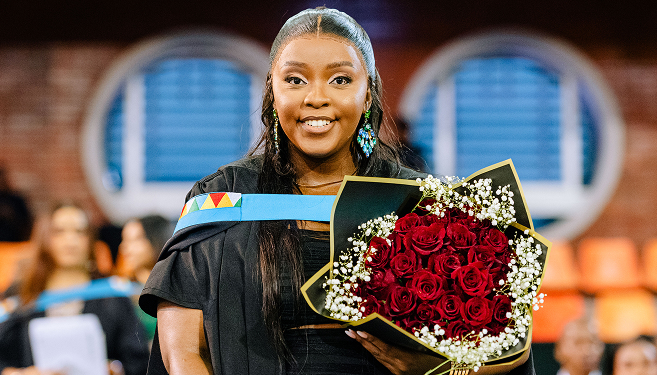
Motivated by a desire to honour her late mother, Ms Hlengiwe Ngubane’s Masters in Architecture explored Africanist thought by investigating how Nguni spiritual healing and biomedical practices can coexist in architectural design.
Her research was informed by personal experience – her mother passed away during the COVID-19 pandemic, when restrictions on church gatherings prevented her from receiving the spiritual support she needed.
‘If a human being is made up of the physical body, the mind, and the soul, then true well-being must address all three aspects holistically. This experience left a lasting impact on me and led to my desire to close the gap between African traditional healing and biomedical healthcare,’ she said.
Using Durban as a case study, Ngubane proposed an architectural model that integrates Western medicine and African traditional healing, particularly within the city where the majority are Nguni people. She highlighted the need to formalise existing informal spaces such as the Muthi market, currently operating without proper infrastructure beneath a bridge.
Ngubane’s research seeks to reimagine a healthcare facility that integrates both systems so that individuals have a choice. She hopes for the development of a model that addresses the shortcomings of the current healthcare setup, where patients often wait months for appointments or, worse, never get seen at all.
‘My goal is to propose architectural solutions that celebrate cultural diversity and promote holistic healing. By accommodating both healing practices, architecture can enhance inclusivity, cultural recognition, and improve healthcare access.’
She kept envisioning a facility that includes both Western and African medicine under one roof, saying that ‘we can offer more immediate care, respect cultural beliefs, and promote holistic healing.’
Her research encountered a significant challenge due to the scarcity of written or published information, especially in academic settings that prioritise documented evidence, resulting to difficulty in access and co-operation from traditional healthcare practitioners and organisations, as many were understandably reluctant to participate in the research.
Participants often hesitated to engage with researchers due to previous experiences in which they had been promised outcomes, such as support or increased awareness, but ultimately those promises went unfulfilled.
Ngubane noted that many lecturers were unfamiliar with African traditional healing systems and hesitant to engage deeply with the topic, which limited the constructive feedback she received during critiques.
This led to a lack of constructive feedback during design critiques and presentations. Instead of meaningful engagement with the design ideas, she often received limited commentary or vague observations, which made it hard to improve or refine her work.
She also shared that participants experienced a lack of support from the biomedical healthcare system, receiving negative test results despite feeling very unwell.
They found greater understanding and care in African traditional healing. Conversely, some initially turned to traditional medicine even when biomedical treatment was necessary for chronic conditions.
These insights highlight the need for a collaborative healthcare system that integrates various healing approaches, promoting better patient outcomes, cultural sensitivity, and holistic care.
Dr Majahamahle Nene Mthethwa, Ngubane’s supervisor said that she was a pleasure to supervise. ‘She demonstrated strong potential for growth in the academic field, particularly through her well-structured research investigation skills,’ said Mthethwa.
Ngubane’s academic journey has included presenting at academic conferences and receiving the Best H&SS Future-Focused Paper Award at the 2023 UIA Congress for Architects in Copenhagen.
She offered words of advice to her peers, stating that pursuing a master’s or PhD is no light journey – it requires deep commitment, resilience, and sacrifice and that ‘these qualifications stretch you mentally, emotionally, and sometimes even spiritually. My advice is to take care of yourself and give yourself grace. Don’t be too hard on yourself. Make your mental health a priority because this path can be overwhelming at times.’
She expressed gratitude to family, friends, fiancé, supervisor, and Ms Nwabisa Mona for their unwavering support, guidance, and inspiration throughout her research journey, expressing gratitude for their steadfast belief in the power of dreams and the support of others.
Lastly, to her mom, she said, ‘May heaven bless you with peace and joy. I felt your presence throughout my journey, especially in moments when I wanted to give up, during my lowest points, and throughout every mental breakdown. Your prayers for me and the dreams you had for my life have always inspired me to keep going. Mama, I did it.’
Words: Sinoyolo Mahlasela
Photograph: Sethu Dlamini