Soil Scientist Listens to Whispers from the Soil
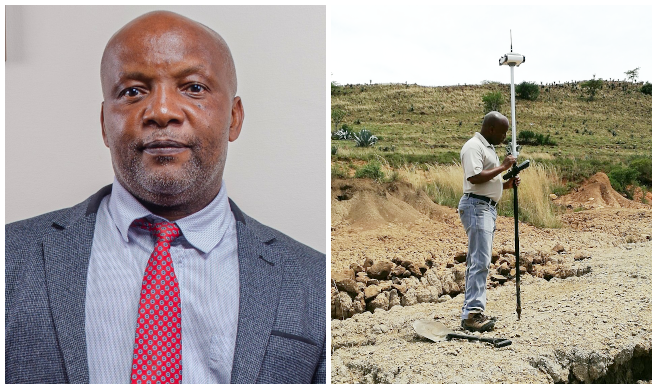
UKZN soil scientist Professor Pardon Muchaonyerwa used his inaugural lecture to outline his strategies to improve agricultural productivity, organic waste management and climate change resilience.
Muchaonyerwa is a Full Professor in the Discipline of Soil Science at UKZN’s College of Agriculture, Engineering and Science.
‘All life depends on the soil,’ he said. ‘The soil is the bedrock for everything, and every soil has its own story.’
Over the past 20 years, Muchaonyerwa’s research group has focused on studying the effects of soil management on erosion, organic carbon, overall fertility and crop productivity.
‘Soil degradation causes a decline in agricultural productivity, food insecurity and climate change, and negatively affects water supply systems,’ he explained. ‘Our studies have mainly focused on regenerative agriculture, including no-till, retention of crop residues, rotation with cover crops, and conversion of organic waste like manures, plant biomass, human hair, faeces and urine into valuable soil amendments.’
Muchaonyerwa noted that regenerative agriculture, including the application of organic waste products, improved organic carbon levels and reduced soil degradability, which is responsible for the siltation of water sources. It also enhanced nutrient cycling and agricultural productivity, addressed waste management challenges and reduced agriculture’s contribution to greenhouse gas emissions and eutrophication (excessive richness of nutrients in a body of water).
He cautioned, however, that monitoring through routine testing is essential in evaluating the benefits of these management strategies in terms of soil quality.
Muchaonyerwa obtained his BSc Agriculture Honours (Soil Science) degree from the University of Zimbabwe (UZ) in 1995 and received a UZ Book Prize for the overall best graduating student in the Faculty of Agriculture. He was awarded his PhD from the same university in 2003. He joined the Department of Agronomy at the University of Fort Hare in 2004 before moving to UKZN in 2011 to take up an Associate Professorship. He was promoted to Full Professor in 2021.
He is known for his work in soil carbon and nutrient cycling for improved agricultural productivity and environmental quality, including mitigation of the causes and effects of climate change. His research focus is on conservation agriculture, organic waste use and nutrient recovery from wastewaters.
Muchaonyerwa has supervised 17 PhD and 43 MSc student to graduation, mentored three postdoctoral fellows and published more than 100 research articles in peer-reviewed journals, conference proceedings and book chapters. He is currently supervising six PhD and three MSc candidates. He has examined numerous theses from 10 universities and is a reviewer for a number of journals in his field. He has served on the Agricultural Project Review Panel for the National Research Foundation (NRF) for several years and continues to review research proposals for the Water Research Commission (WRC) and NRF, and once for National Geographic. He also served as a Guest Editor of a special issue of the journal, Land.
Muchaonyerwa has been an invited speaker at a number of international conferences and workshops in the United Kingdom, Zimbabwe and South Africa. He enjoys an NRF C2 rating and was a recipient of the 2011 Vice-Chancellor’s Emerging Researcher Award from the University of Fort Hare.
He has received numerous research grants from the NRF, WRC, Joint Nature Conservation Committee (JNCC -UK), Umgeni Water, SANBI (DEAT)/ GENOK (Norway), and the Claude Leon Foundation, and has assisted his postgraduate students to apply for funding from several organisations.
Muchaonyerwa is a member of the Soil Science Society of South Africa, Soil Science Society of Zimbabwe, Land Rehabilitation Society of Southern Africa, Centre for the Coordination of Agricultural Research and Development for Southern Africa, and the International Union of Soil Science. He is the Chair of the Professional Advisory Committee of the South African Council for Natural Scientific Professions.
Words: Sally Frost
Photographs: Supplied