Steve Biko Memorial Lecture 2023 – Black Consciousness and Radical Humanism Unpacked
Black consciousness, radical humanism and decolonisation were explored during the 2023 Annual Steve Biko Memorial Lecture hosted by UKZN and the Umtapo Centre.
The lecture – which examined the current state of affairs and challenges in South Africa – was held under the theme: Biko’s Quest for True Humanity in a South Africa that is in Institutional and Moral Decay.
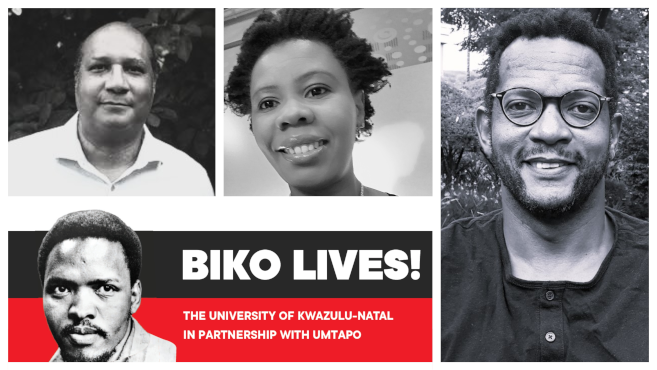
Speakers included University of Connecticut academic Professor Lewis R Gordon, who gave the keynote address; Executive Director of UKZN’s Division of Corporate Relations Ms Normah Zondo; academic leader for teaching and learning at UKZN’s School of Religion Philosophy and Classics, Professor Federico Settler; Umtapo Centre’s Mr Jay Reddy; and the Deputy President of AZAPO and facilitator for the lecture, Ms Kekeletso Khena.
In her welcome address, Zondo said the University was proud to host the lecture as it strived to constantly be at the centre of national debate and effort seeking solutions to challenges confronting the country and the globe. ‘We are proud to be associated with the legacy of Steve Biko, an alumnus of the University,’ said Zondo.
In his keynote address, unpacking the topic: Black Consciousness, Radical Humanism and Decolonisation: Convergence and Limitations, Gordon said Biko’s vision and contributions were very powerful. ‘People talk about democracy but there is no democracy for all, while there is no political life without power,’ said Gordon.
The issue of race was a problem and what became very complicated was ‘the notion of a superior race which already has a problem because it constructs a particular group of people who are above humanity and its project,’ he said. ‘To push below humanity – which is what anti-Black racism also becomes – is an assault on humanity itself.’
Expanding on the Black Consciousness Movement, he said the capital letter B in Black assessed ‘the accession of who we are, our humanity but in our terms.’ He said Biko understood that no group owned humanity and everybody lived it.
Gordon said during his contributions to the foreword of Biko’s book titled: I Write What I Like, what struck him was that Biko had a clear understanding of what it meant to have a lie imposed upon people. ‘People think the only legitimate discourse of Black consciousness is the one that took place in the South African context, but actually, Black Consciousness goes back to the 18th century.’ He said what was different were the contributions, creativity and uniqueness of analysis brought to the concept in the South African context. ‘That was so powerful that it reached us across the globe,’ he added.
Speaking on power, Gordon said there was a big fear about associating the notion of Black with the notion of power. ‘But ultimately what democracy is about is the empowerment of the people. What oppression, colonisation, racism, and the long list of isms are about is the disempowering of the people through the privatisation of power,’ he said.
‘There’s the cliché “power corrupts”, but power corrupts if you set the conditions for power to be corrosive. Most people think about power over domination but they don’t think about the question of what it means to have the ability to act. All power means is the ability to make things happen with access to the conditions of doing so. If you don’t have access to those conditions, you can’t do anything.’
Replying to Gordon, Settler praised Gordon for his talk and said he was honoured to be responding to the keynote address because of the shared common interest he had with the speaker. Among the questions he raised, Settler asked how Gordon viewed the country as it prepared for radical humanism when people continue to be marginalised? How 30 years later, the people were still asking about this liveable future we were in pursuit of? And what it meant to be free?
In his response, Gordon thanked the audience for engaging with him. He said one of the errors we had inherited was the reductive thinking of looking at ourselves and the world as things. ‘We live in a disclosed reality called the human world and, in that world, when we are drained of it, we suffer despair. Part of what it is to live liveable lives requires the communicative practices through which we connect.’
He said apartheid South Africa created safe mechanisms for White people and the standard of living that socialism for the Whites afforded them, including some of his relatives, was unbelievably high. He said the idea of making a transition in 1994 without those mechanisms in place for the whole society was a recipe for disaster. He said a post-apartheid South Africa with billionaires and millionaires might appear to be a good society but if it still had people that had to walk three hours to get a few Rands to be able to get a slice of bread it was not reflective of a healthy society.
In closing the lecture and providing the vote of thanks, Reddy thanked the speakers, participants and organisers for being part of the event. He said the lecture held in partnership with the University had over the years brought wonderful discussions to the numerous audience members who had participated.
Umtapo Centre has hosted the Steve Biko lecture series for the past 15 years.
The lecture is available on YouTube through this link:
https://www.youtube.com/watch?v=ucKTbHIt8Ng&t=163s
Words: Sithembile Shabangu
Photographs: Supplied