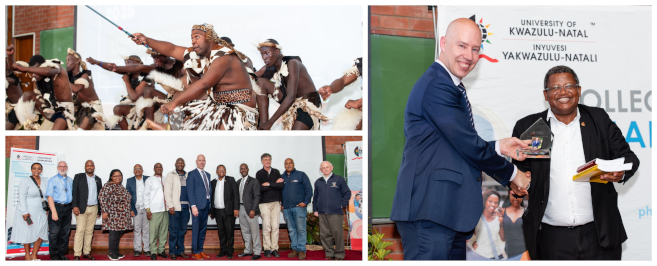
Each year, those whose lives have been touched by Professor Steve de Gruchy gather to honour his legacy as a renowned and well-respected academic, passionate about the University, his teaching, and his calling as an ordained theologian.
His contributions extended beyond scholarship and activism – he was also a gifted songwriter, crafting Christian liturgies and musical expressions from a young age and throughout his life.
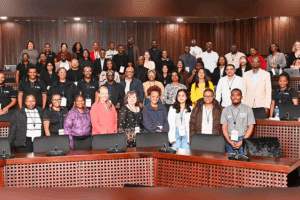
The annual Steve de Gruchy Memorial Lecture, hosted by the School of Religion, Philosophy and Classics (SRPC) in the College of Humanities – alongside the Centre for Constructive Theology, the Maurice Webb Chair, and the KwaZulu-Natal Christian Council – serves as a space to pause, reflect, and explore how de Gruchy’s work remains relevant today.
Representing UKZN, Professor Simangaliso Kumalo, Dean of the SPRC and Professor Nhlanhla Mkhize, Deputy Vice-Chancellor and Head of the College of Humanities welcomed guests, both acknowledging de Gruchy’s contributions to academia and theology.
‘This is more than just an academic event,’ said Mkhize, ‘it is an opportunity to reflect on de Gruchy’s belief in the power of faith and justice for a better world. Universities have an obligation to be places of growth where barriers are broken and de Gruchy’s action orientated work managed to achieve this.’
Introducing the theme of this year’s lecture, “The Trump Presidency and Race Issues in the United States and South Africa”, Mkhize noted the importance of exploring how societies grapple with race, identity, and justice and invited guest speaker Dr Deryck Barson to the stage.
Barson, a theologian, pastor, and scholar specialising in historical and systematic theology, is an adjunct professor at Westminster Theological Seminary in Philadelphia. A seasoned church leader, he has held senior pastoral roles in American Presbyterian churches and is an accomplished author with an upcoming book titled Beholding God: An Invitation to Skeptics, Seekers, and Believers.
When Trump won the election, the American civil rights organisation, the National Association for the Advancement of Colored People (NAACP), called it “unhistoric”.
To understand why, Barson’s speech took the audience on a factual and, at times, painful journey through America’s racialised history to establish an understanding of how a second Trump Presidency became a reality.
In an emotive and sobering address, Barson traced the troubling legacy of slavery, the Jim Crow era – after which apartheid was modelled – the mass incarceration of African American men, and ongoing economic injustice faced by Black communities in the US.
Through his interrogation of the past, he revealed the familiar race patterns at play and questioned the role of the ‘White Evangelical Church’ in reinforcing these racist tropes. ‘What must also be acknowledged is the racist past of White churches and its history in siding with the mentality of the empire – choosing profits over people,’ he said. ‘Trump’s Make America Great Again slogan is merely a call to revive the values of Whiteness upheld by these churches.
Trump claims that America is now in its golden age,’ said Barson. ‘But for whom do these words ring true? I fear it’s only for the wealthy – not the dispossessed.’
However, Barson emphasised that we cannot give up – either in America or in South Africa.
‘The future of the oppressed and the oppressor are intertwined, and our Churches have an important role to play in leading this reconciliation. True reconciliation as described in the scriptures requires repair and truth telling,’ Barson said.
Drawing on similarities between America and South Africa’s apartheid past, Barson said, ‘With the help of our Churches, we must serve each other. Love is the only way of life and the only way to transform an enemy into a friend. We must not be afraid to speak truth to power and we must let our Church shine bright on our lands.’
Words: Jennene Naidu
Photographs: Hesper Media