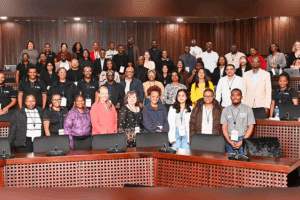
Workshop Examines the Management and Investigation of Violent Protests
UKZN partnered with the National Prosecuting Authority (NPA) to host a workshop on the management of violent protests on campuses.
Guided by prosecutors from the NPA, it was attended by the University’s Risk Management Services (RMS) staff as well as stakeholders from eThekwini Metro Police and the South African Police Service (SAPS).
In her welcome remarks, Ms Normah Zondo, Executive Director: Corporate Relations said, ‘We are gathered here to deliberate upon a subject of profound significance to society at large – the management of violent protests and how our officers can investigate cases for successful prosecution.’
Commenting on the influence the discussions will have in shaping the social fabric of the future, she said that universities are microcosms of society and reflect the conflicts and tensions that exist amongst communities.
Said Zondo, ‘It is for this reason that we are continuously searching for ways in which we can avert some of these protests and in some cases better manage them. Also important is the issue of investigating some of these protests and general crimes which tend to be violent.’
Advocate Amy Kistnasamy noted that protestors are supposed to engage in peaceful mobilisation but of late many leaders and activists have been intent on violence, enabling criminals to use protests as a way of pursuing their criminal activities. ‘Today most people’s empathy and sympathy towards students is at an all-time low. Parents are worried about the lack of learning, universities are concerned about the destruction of property, and taxpayers are also disturbed by the misuse of resources.’
Kistnasamy added, ‘With law enforcement officials, the NPA and universities all being blamed for the lack of action against these criminals, this workshop aims to bring stakeholders together in order to find solutions.’
Advocate Sagren Naidoo said that the NPA, SAPS and Metro Police are governed by the constitutional duty to uphold the rule of law. He remarked on the disconnect between police officers on the ground and detectives. Naidoo stressed the need for proper statement making in linking the accused to the crime, as well as the importance of law enforcement officials being trained on the various offences, statement taking and submission of video footage as evidence.
He encouraged police officers to take initiative by following up with investigative officers and prosecutors when their cases are thrown out, and added that it is illegal to wear balaclavas during protests.
Advocate Roshiela Benimadho reviewed the landscape and offences in relation to violent protests. Using case studies from the #FeesMustFall campaign, as well as the looting cases in July 2021 as examples, she said that it is problematic when protests turn to unrest. She highlighted every citizen’s right to protest, but emphasised that this is not an absolute right as protests should remain peaceful and unarmed. Highlighting the legal position of gatherings, she noted recent court judgements and stated that protestors are not required to give legal notice of a gathering. ‘It is the responsibility of the police to manage the gathering, however, the gathering may still be prohibited if the police are of the opinion that it will lead to injury or destruction of property.’
She further emphasised the need for law enforcement to be in a constant state of readiness. Benimadho thereafter focused on the statutory and common law charges pertaining to violent unrest situations – for example – damage to essential infrastructure. The docket studies highlighted various investigation techniques used in successful prosecutions, with the purpose of the session being to set the foundation of a zero-tolerance approach to criminality during protests.
Mrs Surekha Marimuthu explained the doctrine of common purpose. She used case law and docket studies to explain criminal liability where persons act as a group, for example, in public violence, and also reviewed the importance of cellphones as permissible evidence in crimes.
Questions asked during the interactive session included how RMS is expected to mitigate risk as officers that are unarmed as well as where the loyalty of private security companies lies and who they are obliged to protect.
Superintendent Lorraine Khuzwayo of eThekwini Metro Police thanked the NPA for delivering an eye-opening programme and said that the key to success would lie in working together and good communication. She added that her division would be reaching out for more advice and assistance in the future.
In his closing remarks, RMS Director Mr Lovemore Khumalo thanked the University, the NPA, SAPS and Metro Police for attending. He said the event highlighted the importance of stakeholder engagement, communication, commitment and training. ‘The aim is to revive existing structures and as a University we are committed to supporting these programmes and making sure that they are fast-tracked.’
Words: Hlengiwe Khwela
Photograph: Zama Khoza