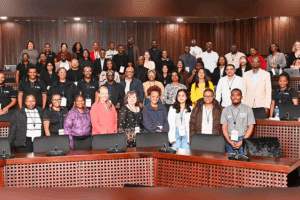
‘The Future of Urban Development’ was the theme of a seminar organised by the University of KwaZulu-Natal’s (UKZN) School of Social Sciences to celebrate World Cities Day.
The event, which brought together scholars, planners and researchers, created a vibrant platform for discussing evolving challenges and opportunities shaping cities in South Africa and across Africa.
The South African Research Chairs Initiative (SARChI) Chair for Inclusive Cities, Professor Hangwelani Magidimisha-Chipungu, said the seminar was a follow-up to the recent International Conference on Inclusive Cities. “Today’s discussions draw from those conversations, especially the issues we could not conclude at the conference.”
Magidimisha-Chipungu emphasised that the dialogue remained essential as cities grappled with questions of resilience, sustainability and long-term growth.
The seminar featured a diverse panel whose members unpacked some of the most pressing questions confronting African cities. A central debate queried whether African urban environments can meaningfully pursue resilience and smart-city strategies while still facing entrenched poverty and homelessness.
Magidimisha-Chipungu noted that rapid urban change was inevitable:
“Cities will look very different in the coming years to how they look today. Global warming, pollution, disease, financial instability, and energy pressures are all linked to how our cities grow. City expansion does not automatically mean more problems, the real question is how we plan and manage that expansion.”
Professor Lovemore Chipungu reflected on the strategic role of green belts in sustainable spatial development. “Green belts are a vital planning tool,” he explained. “They help define city boundaries, promote the regeneration of brownfield sites and ensure we use available land responsibly before expanding outward.”
He emphasised the environmental importance of green belts, describing them as natural buffers that reduce flooding, purify air, contain urban sprawl, and strengthen climate resilience.
Professor Michael Hardman addressed emerging agricultural models within urban systems, highlighting the promise and pitfalls of vertical farming, hydroponics, and smart agricultural innovations.
“These solutions may ease pressure on traditional systems, but many have failed because the business models are not sustainable,” Hardman cautioned. Crucially, he emphasised that technological solutions should not distance food production from the people they were meant to serve.
“There is a real concern that smart agricultural systems may detach production from communities. Communities must remain at the centre of any creative or radical ideas we introduce,” he said.
In her contribution, Professor Claudia Loggia emphasised the critical need to empower communities within urban planning and disaster-mitigation strategies.
“When we talk about innovation – whether responding to natural disasters or humanitarian crises – we need to put the focus back on communities,” Loggia said. “We must co-design strategies with them and ensure that solutions speak directly to their needs.”
She stressed that innovation extended beyond technology, highlighting that meaningful collaboration was the true driver of sustainable progress. “Any new solution must be designed with the community, not imposed on the community.”
Click to watch the full clip.
Words: Sinoyolo Mahlasela
Image: Shutterstock